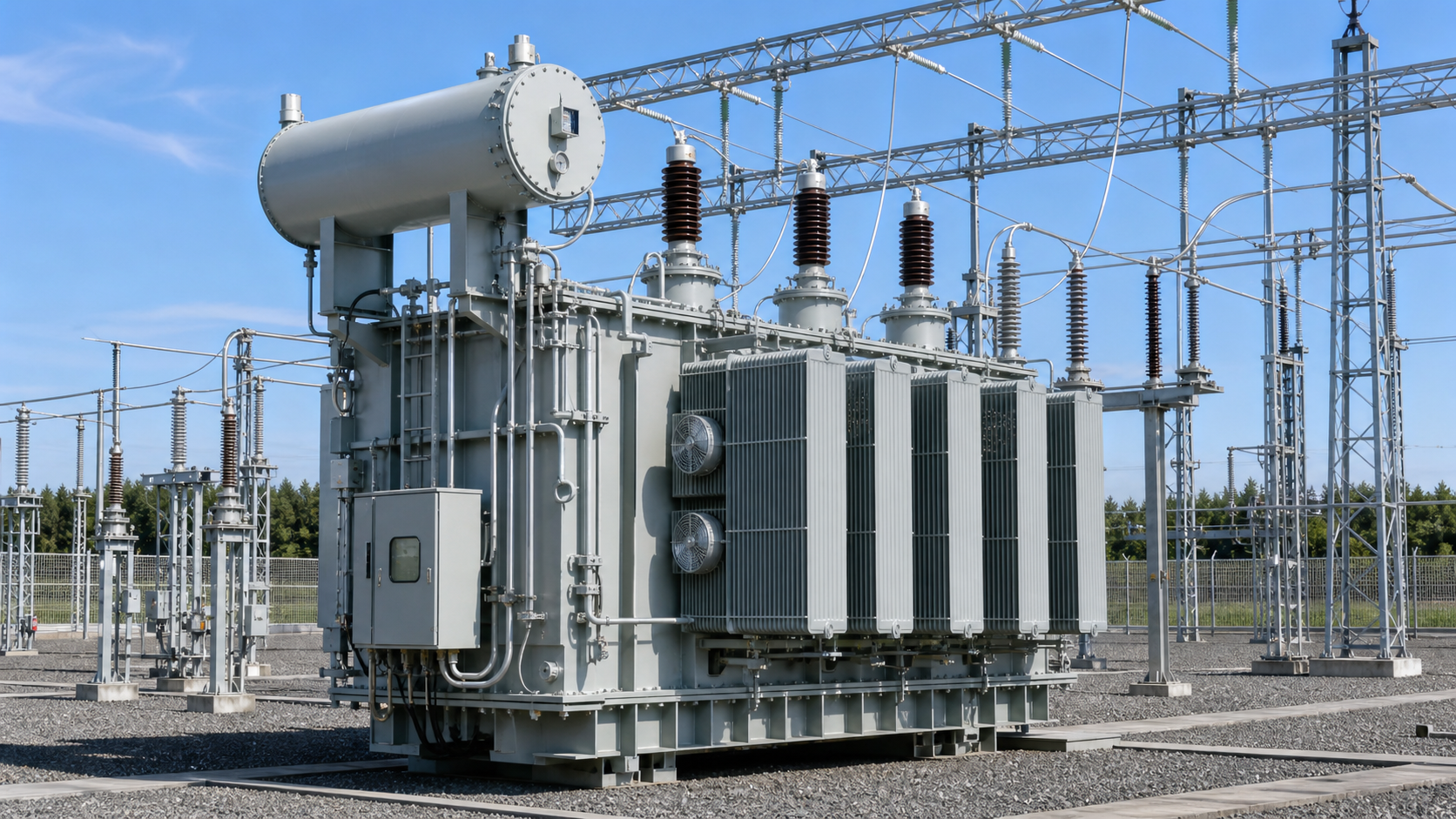
Power Substation Transformer
High-voltage oil-immersed power transformers for utility transmission and distribution substations, industrial facilities, and renewable energy interconnections. Rated from 1 MVA to 100+ MVA at primary voltages from 34.5 kV to 345 kV.
Utility-Grade High-Voltage Power Transformation
Power substation transformers perform the critical step-down of transmission-level voltage to sub-transmission and distribution levels, enabling economical bulk power transfer across the grid while supplying utilization voltage to industrial and commercial loads. They are the most technically demanding class of transformer, operating continuously at high voltage and power levels for decades.
- ONAN, ONAF, ONAN/ONAF, ONAN/OFAF cooling arrangements
- On-load tap changer (LTC) or de-energized tap changer (DETC)
- Standard and non-standard impedance values by specification
- Two-winding and autotransformer configurations
- Buchholz relay, thermal image, winding temperature monitoring
- Full factory testing to IEEE C57.12.90 test procedures
What's Included
- Conservator tank with Buchholz gas relay
- Oil temperature and winding temperature indicators
- Pressure relief device and sudden pressure relay
- Oil level gauge with alarm contacts
- De-energized tap changer (DETC) — standard
- Copper or aluminium winding conductors
- Core and coil construction to IEEE C57.12.00
- High-voltage and low-voltage bushings to IEC / IEEE
- +On-load tap changer (LTC) — ±10 taps × 1.25% or 1.5% per step
- +ONAN/ONAF or ONAN/OFAF forced cooling upgrade
- +Cooling radiator banks with thermostatic fan control
- +Nitrogen gas blanketing system
- +Automatic voltage regulator (AVR) for LTC control
- +Transformer monitoring system (TMS) with remote SCADA interface
- +Fibre optic distributed temperature sensing (DTS)
- +Line surge arresters on HV and LV bushings
Full Specifications
| Parameter | Value |
|---|---|
| MVA Rating | 1 MVA – 100+ MVA (project-specific) |
| Primary Voltage (HV) | 34.5 kV – 345 kV |
| Secondary Voltage (LV) | 4.16 kV – 69 kV (project-specific) |
| Winding Configuration | Two-winding or autotransformer |
| Cooling Class | ONAN / ONAF / ONAN/ONAF / ONAN/OFAF |
| Insulating Fluid | Mineral oil (standard) / FR3 ester (option) |
| HV Taps | DETC standard; LTC available |
| Impedance | Per project specification (IEC / IEEE) |
| Temperature Rise | 65°C (oil) / 80°C (winding) — standard |
| Vector Group | Project-specific (Dyn11, YNyn0, YNd11, etc.) |
| Primary Standard | IEEE C57.12.00 / IEC 60076 |
| Canadian Certification | CSA C88 |
| Frequency | 60 Hz (50 Hz available) |
Built to Standard



Where It's Used
- Utility transmission and distribution substations
- Industrial facility main power stations
- Mining operations and remote site power supply
- Renewable energy plant interconnection (wind, solar, hydro)
- Oil and gas upstream and midstream facilities
- Steel mills and electric arc furnace supply
- Data centre utility supply points
- Rail and transit traction substations
From design and specification through factory testing, commissioning, and ongoing maintenance — Candron delivers at every phase.
- Engineering drawings and coordination studies
- Factory acceptance testing (FAT) with full reports
- Site commissioning and protection settings
- Spare parts, training, and maintenance support
Common Questions
ONAN (Oil Natural, Air Natural) is the basic self-cooled rating with no forced cooling. OFAF (Oil Forced, Air Forced) uses oil pumps and air fans to achieve a higher continuous MVA rating from the same core and coil assembly. Most large power transformers are rated at two or three cooling stages (e.g., ONAN/ONAF/OFAF) with automatic staging based on thermal sensors.
A load tap changer allows voltage regulation under load — adjusting the turns ratio while the transformer is energized. LTCs are specified when the secondary voltage must be held within a narrow band regardless of load variation or primary voltage fluctuation. They add cost and maintenance requirements; for applications with stable utility voltage and predictable loading, a DETC is often sufficient.
Standard factory tests include: winding resistance measurement, turns ratio test, no-load loss and excitation current measurement, load loss and impedance measurement, applied potential (HV) test, and induced potential test. Optional tests include partial discharge, temperature rise, lightning impulse, and audible sound level. Full test reports are provided with every unit.
Yes. We specify and supply transformers to either ANSI/IEEE or IEC standards, or a hybrid specification acceptable to both, depending on your project requirements. Most Canadian utility projects reference IEEE/CSA standards, while many international projects use IEC 60076 series standards.
Ready to Spec
Your Project?
Our engineering team responds with specs, lead times, and pricing the same day. Tell us what you need:
- MVA rating (ONAN base, with cooling upgrade ratings if known)
- Primary voltage (HV) and BIL
- Secondary voltage (LV) and BIL
- Vector group / winding connection
- Impedance target (% on transformer MVA base)
- Tap changer requirements (DETC or LTC, range and steps)
- Cooling class and forced cooling requirements
- Applicable standards (IEEE/CSA or IEC)
Send us your project details and we'll respond with a price, lead time, and any clarifying questions — typically within a few hours.
Request a Quote →Or call us directly